Think of a commercial cleaning contract as the blueprint for your relationship with a client. It's the essential document that turns a handshake deal into a professional, legally-sound partnership, laying out the scope, payment terms, and responsibilities for everyone involved.
Why Your Cleaning Business Needs a Strong Contract
Let's be honest, contracts can feel like a chore. But in the commercial cleaning world, a solid, well-written contract is probably the most valuable tool you have for growing your business. It's so much more than just a legal document—it’s the entire framework for a great client relationship, building immediate trust and making sure expectations are crystal clear from day one.
In an industry where reliability is everything, a professional agreement is your best defense against the common misunderstandings that can sour partnerships and, worse, lead to unpaid invoices. It instantly positions your business as a serious, professional operation, not just another fly-by-night service.

Building Trust and Professionalism
A well-crafted contract does more than just list out services—it communicates credibility. When you hand a potential client a clear, comprehensive agreement, you're showing them you're organized, professional, and serious about your commitments. That first impression can easily be the deciding factor in landing a long-term, high-value client.
Think about it: the contract is often the very first tangible thing your client receives from you. It sets the tone for the entire professional relationship.
Defining Clear Expectations
Ambiguity is the absolute enemy of any successful service relationship. Without a contract, a simple request to "clean the office" is completely open to interpretation, and that's where problems start. A detailed agreement gets rid of the guesswork by spelling out every single task.
Your contract should clearly outline things like:
- Specific Areas Covered: Which rooms, offices, hallways, and common areas are included in the service?
- Frequency of Tasks: Is trash removal daily? Are floors mopped weekly? Are windows cleaned monthly? Get it all in writing.
- Scope of Services: What is—and more importantly, what is not—included in the price. This is your best tool for preventing "scope creep," where clients slowly start asking for extra work that wasn't part of the original quote.
Getting this level of detail down ensures you and your client are on the same page right from the start. You can get a better feel for this by reviewing the essential questions to ask before hiring a cleaning service.
A contract isn't about mistrust; it's about clarity. It’s a roadmap that both parties agree to follow, ensuring a smooth journey and preventing wrong turns that could damage the relationship.
Protecting Your Business in a Growing Market
The demand for professional cleaning services is absolutely booming. The global contract cleaning market was valued at around $388 billion in 2023 and is projected to keep expanding. You can find more insights about this expanding market on Grand View Research.
This growth means more opportunities, but it also means more competition and greater risk.
A strong contract is your shield. It legally protects your business by locking in payment terms, liability limits, and clear termination clauses. It makes sure you get paid on time, protects you from unfair claims, and gives you a clear exit strategy if a partnership just isn't working out. Simply put, it's an indispensable tool for building a sustainable business in this competitive field.
Breaking Down the Essential Contract Clauses
Think of your commercial cleaning contract as the blueprint for your business relationships. It’s not just a pile of legal jargon; it's the rulebook that protects your company, defines the client partnership, and makes sure you get paid for your hard work. Nailing these details upfront saves you from major headaches down the road.
A vague contract is an open invitation for problems. When clauses aren't crystal clear, clients can misinterpret what they're getting, which often leads to scope creep and you doing work for free. Let's walk through the core pieces you absolutely must have to build a solid, clear, and fair agreement.
The Scope of Services Clause
This is where the rubber meets the road. The Scope of Services, sometimes called a Scope of Work (SOW), is the heart of your entire agreement. It needs to spell out exactly what cleaning tasks you'll do, where you'll do them, and how often.
Ambiguity is your worst enemy here. Don't just say "clean restrooms." Get specific:
- Daily: Empty trash, sanitize toilets and urinals, wipe down countertops and sinks, refill all dispensers.
- Weekly: Mop floors with disinfectant, clean mirrors until they're streak-free.
- Monthly: Dust high-level fixtures, vents, and ledges.
This level of detail leaves zero room for misunderstandings. It’s your backup when a client claims you missed something and acts as a clear checklist for your cleaning crew. Plus, it helps justify your pricing by showing the client exactly what they’re paying for.
Payment Terms and Conditions
This clause is all about the money—how much you’re charging, when it’s due, and how you expect to be paid. If this section is weak, it can seriously hurt your cash flow. You have to be direct and clear to ensure you get paid on time, every time.
Your payment section should lay out:
- Total Cost: The flat monthly or per-service fee.
- Due Dates: "Payment is due within 15 days of the invoice date."
- Accepted Payment Methods: ACH transfer, credit card, or check.
- Late Fee Policy: "A late fee of 5% will be applied to any invoice not paid within 30 days."
Being upfront about payment terms isn't rude; it's just smart business. It sets a professional boundary and keeps your company financially healthy.
A well-defined contract serves as a legally binding agreement that outlines all responsibilities, service standards, and payment terms. Using a professional commercial cleaning contract template is now a fundamental practice for standardizing offerings and protecting your business. Learn more about the importance of professional standards in the cleaning industry from BizPlanr.ai.
Term and Termination Clause
Every good partnership needs a clear beginning and an end. The Term and Termination clause sets the contract's lifespan and explains how either you or the client can end the agreement.
This section usually covers:
- Initial Term: How long the first agreement lasts (e.g., one year).
- Renewal: Whether the contract auto-renews. For instance, "This agreement will automatically renew for subsequent one-year terms unless either party provides 60 days' written notice of non-renewal."
- Termination for Cause: The reasons for immediate cancellation, like the client not paying you or a major contract breach.
- Termination for Convenience: The notice needed if one party wants out for no specific reason (e.g., 30 days' written notice).
This clause gives you both security and a practical exit strategy, so you aren't stuck in a bad client relationship that’s losing you money.
Liability and Insurance Clause
Let's face it, accidents can happen. This clause is your safety net, protecting your business from financial disaster if something goes wrong on a job. It also shows the client you’re a serious, professional company they can trust.
You need to clearly state that you carry the right insurance. Be specific about the types and amounts of coverage:
- General Liability Insurance: This covers property damage or bodily injury. A $1,000,000 minimum per occurrence is pretty standard.
- Workers' Compensation: Protects your employees if they get hurt on the job.
- Bonding: This gives the client financial protection if one of your employees is accused of theft.
Attaching a copy of your Certificate of Insurance (COI) to the contract is always a great move. It’s proof that you’re a responsible business owner who’s prepared for anything.
To help you keep track, here’s a quick-reference table summarizing the must-have clauses for any commercial cleaning contract.
Essential Clauses You Cannot Afford to Miss
| Clause | Purpose | Key Consideration |
|---|---|---|
| Scope of Services | To detail every cleaning task, its frequency, and location. | Be hyper-specific to avoid scope creep. "Clean floors" isn't enough. |
| Payment Terms | To outline the cost, due dates, payment methods, and late fees. | Clearly state your late fee policy to encourage timely payments. |
| Term & Termination | To define the contract's length and the rules for ending it. | Include an "auto-renewal" clause with a clear notice period for non-renewal. |
| Liability & Insurance | To protect your business and reassure the client by proving you have proper coverage. | Always specify the coverage amounts and attach your Certificate of Insurance (COI). |
| Confidentiality | To protect sensitive client information your team may encounter. | Important for clients in healthcare, legal, or financial industries. |
| Dispute Resolution | To establish a process for handling disagreements without going straight to court. | Consider adding a clause for mediation as a first step to save time and money. |
Getting these clauses right from the start is non-negotiable. It sets the foundation for a professional relationship, protects your business, and ensures everyone is on the same page from day one.
Defining a Clear Scope of Work That Prevents Confusion
The Scope of Work is the absolute heart of your commercial cleaning contract template. I’ve seen it time and time again—this is where agreements either become a huge success or a complete nightmare. If your scope is vague, you're setting yourself up for missed expectations, unhappy clients, and endless arguments over what was supposed to get done.
Think of this section as the detailed playbook for your team and the concrete promise you’re making to your client. It’s all about turning your initial walkthrough and conversation into a crystal-clear checklist that leaves zero room for misinterpretation. We need to go from fuzzy to focused.
From Vague Requests to Specific Actions
So many client conversations start with simple phrases like "clean the office" or "just handle the restrooms." It's your job to translate those requests into specific, measurable tasks. This is how you protect yourself from scope creep and, just as importantly, show the client exactly what they're paying for.
Vague language is your worst enemy. Instead of a line item that just says "clean floors," your contract should spell it out: "Floors will be vacuumed nightly and mopped to a streak-free finish every Wednesday and Friday." That one sentence nails down the action, the frequency, and the quality standard.
Here’s another real-world example for an office breakroom:
- Vague: "Tidy up the breakroom."
- Specific: "Wipe down all countertops and tables, clean the microwave interior and exterior, sanitize the sink and faucet handles, and restock paper towel dispenser daily."
Getting this granular ensures everyone is on the same page. It also becomes an invaluable training guide for new staff and a quality control checklist for your supervisors.
Structuring Service Frequencies Effectively
Let's be real—not every task needs to be done daily. Breaking down your Scope of Work by frequency (daily, weekly, monthly, quarterly) is a smart way to organize the contract and manage client expectations. It also makes your pricing much easier to explain and justify.
Daily Tasks (High-Traffic & High-Touch Areas)
These are the non-negotiables. They keep the facility looking and feeling clean every single day.
- Emptying all trash and recycling bins.
- Sanitizing doorknobs, light switches, and elevator buttons.
- Cleaning and sanitizing all restroom fixtures.
- Spot-cleaning glass doors and entryways for fingerprints.
Weekly Tasks (Deeper Cleaning)
These are the jobs that maintain the overall shine and prevent dirt and grime from building up.
- Dusting all horizontal surfaces, including desks, shelves, and window sills.
- Vacuuming all carpeted areas and mopping hard-surface floors.
- Polishing stainless steel surfaces in kitchens and elevators.
Monthly or Quarterly Tasks (Periodic Maintenance)
These are less frequent but absolutely critical for the long-term upkeep of the facility.
- High-level dusting of vents, light fixtures, and ceiling corners.
- Deep cleaning carpets or waxing floors.
- Washing interior windows.
If you need a solid foundation to build these lists, our detailed commercial cleaning checklist is a great resource you can adapt for any client.
The best Scope of Work sections don't just list tasks; they build a system. When you categorize duties by frequency, you're giving both your team and your client a clear, logical plan that everyone can understand and follow.
As you can see below, a clear scope, fair payment terms, and solid liability coverage are the three pillars of a bulletproof contract.
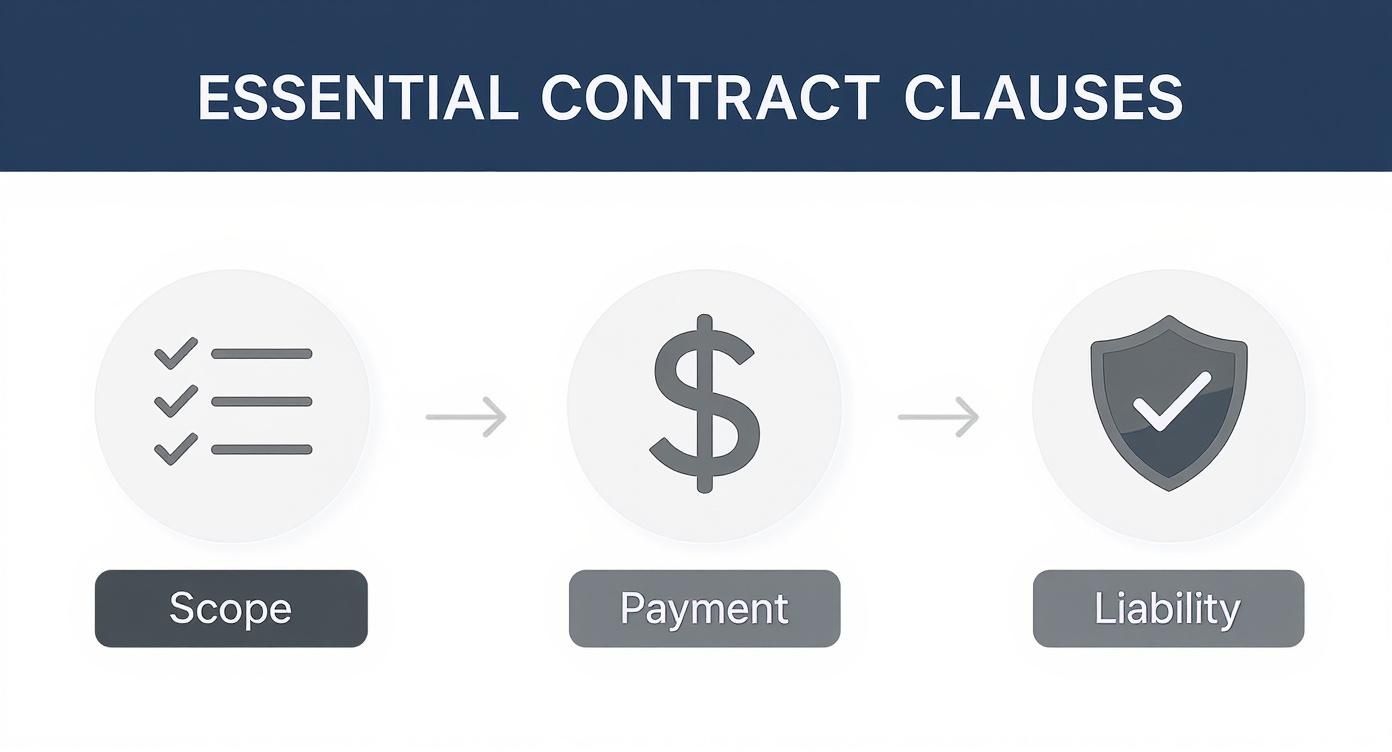
This really drives home that defining the scope is the first, most critical step. Everything else—from how you bill to the insurance you need—flows directly from it.
Building in Flexibility for Special Requests
Even the most buttoned-up contract needs a bit of wiggle room. Your client will inevitably need a one-off deep clean before a big corporate event or some post-construction cleanup after a small office renovation. Building this flexibility right into your commercial cleaning contract template shows you’re an adaptable partner, not a rigid vendor.
You’ll want to include a specific clause that outlines exactly how to handle these one-off jobs. Make sure it specifies:
- How to submit special requests (e.g., via email with 48 hours' notice).
- How the work will be priced (e.g., at a set hourly rate or a flat-fee quote).
- How it will be invoiced (e.g., added to the next monthly bill or billed separately).
Putting this in writing prevents those extra jobs from becoming unpaid "favors" and sets up a professional process for handling anything outside the regular schedule. It ensures you get paid fairly for all your work while still meeting your client's changing needs.
Structuring Pricing and Payment Terms for Profitability
Let's talk about the money conversation. Getting this part right in your commercial cleaning contract template is non-negotiable for a healthy business. This isn’t just about what you charge; it’s about creating steady cash flow, protecting your profit margins, and setting professional financial boundaries from day one. When your pricing structure is crystal clear, you avoid awkward phone calls and guarantee you're paid fairly for your hard work.
The contract cleaning industry is a serious operational expense for most businesses. To give you some perspective, the European commercial cleaning market was valued at around USD 126.69 million in 2024 and is only expected to grow. You can see more data on the contract cleaning market from Fortune Business Insights. This is why your contract’s financial terms need to be precise, leaving no room for interpretation.
Choosing the Right Pricing Model
There’s no magic bullet for pricing commercial cleaning jobs. The best model really depends on the client, the building, and the scope of work. Your contract needs to clearly spell out how you got to the final number.
Here are the three most common ways we price jobs in this industry:
- Flat Monthly Rate: This is the go-to for most ongoing contracts. It gives both you and your client predictable numbers to work with. It's perfect for standard office buildings or retail shops where the cleaning routine doesn't change much.
- Hourly Rate: This is your best bet for jobs that are hard to predict, like a one-off deep clean or a messy post-construction cleanup. If you go this route, I highly recommend specifying a minimum number of hours in your contract to make the job worthwhile.
- Per-Square-Foot Rate: We often use this to put together initial quotes for huge facilities—think warehouses or big office towers. You calculate the price by multiplying the cleanable square footage by a set rate, which can change based on things like floor type or how cluttered the space is.
For example, a small, straightforward dental office is a perfect candidate for a flat monthly rate. But for a massive, sprawling warehouse with different needs in different zones, a per-square-foot model is a much better starting point for the bid, which you can then convert to a monthly fee.
Pro Tip: Don't forget about your supplies! Your contract has to state who is buying the chemicals, paper towels, and equipment. You can either build the cost into your rate or list it as a separate line item. Check out our guide on the essential supplies for a cleaning service to make sure you've got it all covered.
Essential Payment Clauses to Include
Once the price is set, you need to lay down the law on how and when you get paid. Vague terms are a recipe for late payments, which can absolutely crush a small business. Your contract’s payment section has to be direct and impossible to misunderstand.
Here are the key clauses you must include:
- Payment Due Date: Never leave this open-ended. Use direct language like, "Payment is due in full within 15 days of the invoice date."
- Accepted Payment Methods: Tell them exactly how they can pay. For example: "Payments may be made via ACH bank transfer, company check, or credit card (a 3% processing fee applies to all credit card payments)."
- Late Fee Policy: This is your best defense against late payers. A standard clause looks like this: "A late fee of 5% of the outstanding balance will be applied to any invoice not paid within 30 days of its due date."
- Price Adjustment Clause: Your costs go up, and client needs change. Your contract needs to account for this. Here’s some sample language: "The monthly service fee is subject to an annual review and may be adjusted with 60 days' written notice to the Client. Any client-requested changes to the Scope of Work will be quoted separately and approved in writing before work commences."
These clauses are your safety net. They create a clear, professional financial structure that prevents headaches and makes sure the money you earned actually makes it to your bank account.
How to Handle Insurance and Liability Like a Pro
Let's be real: protecting your business isn't just paperwork—it's non-negotiable. Accidents happen. It's not a matter of if, but when. A floor is left slick, an expensive piece of office tech gets broken, or one of your crew members gets hurt on the job.
This is exactly why your commercial cleaning contract needs a rock-solid clause covering insurance and liability. Think of it as a safety net for both you and your client.
Showing proof of proper insurance isn't just a formality; it's a powerful signal. It tells potential clients you're a serious, professional business that takes full responsibility. Honestly, this one clause can be the deciding factor that gets you hired over a less-prepared competitor.
Understanding Bonded vs. Insured
You'll hear clients ask if you are "bonded and insured," and you absolutely need to know the difference. While both offer protection, they cover completely different kinds of risk.
- Insured: This means you have liability insurance. If your team accidentally damages a client's property (like knocking over a server rack) or someone gets injured (a classic slip-and-fall), your General Liability Insurance covers the costs. It's your shield against property damage and injury claims.
- Bonded: A surety bond protects your client from employee theft. If one of your staff is convicted of stealing from the client's office, the bond reimburses the client for their loss up to the bond's limit.
Being both bonded and insured is the gold standard in our industry. It gives clients complete peace of mind, making them feel secure handing you the keys to their business.
Must-Have Insurance Coverage in Your Contract
Your contract has to be crystal clear about the types and amounts of insurance you carry. To handle insurance like a true pro, you need a firm grasp of the various essential commercial insurance types so you can build robust protection right into your agreement.
At an absolute minimum, your contract must specify:
- General Liability Insurance: This is non-negotiable. It covers property damage and third-party bodily injury. A minimum coverage of $1,000,000 per occurrence is the industry standard, and you shouldn't settle for less.
- Workers' Compensation Insurance: If you have employees, this is legally required in most states. It covers medical bills and lost wages if an employee gets hurt on a client's site, protecting you from potentially devastating lawsuits.
Sample Wording: "Service Provider agrees to maintain a General Liability insurance policy with a minimum coverage of $1,000,000 per occurrence and Workers' Compensation insurance as required by state law. A Certificate of Insurance (COI) will be provided to the Client upon request."
Shielding Your Business with an Indemnification Clause
An indemnification clause, sometimes called a "hold harmless" clause, adds another crucial layer of legal protection. In plain English, it means the client agrees not to hold your company responsible for any losses or damages that aren't a direct result of your team's negligence.
Imagine this scenario: a client's own employee trips over a misplaced box they left in the hallway and tries to blame your cleaning crew. This clause is your defense. It clarifies that your liability is limited to incidents directly caused by your company's actions.
Including this shows foresight and a professional approach to risk management. It gives you the confidence to run your business knowing you're well-protected.
Get Your Free, Customizable Contract Template
Alright, you've learned the essentials. Now it’s time to put that knowledge to work. We’ve put together a comprehensive commercial cleaning contract template you can download for free, specifically designed for small and medium-sized businesses like yours.
This isn’t some generic, fill-in-the-blanks document. It’s a practical tool I’ve refined to help cleaning pros secure better clients and, just as importantly, protect their businesses.
You can get it in Microsoft Word or Google Docs—whatever works best for you. It includes all the critical clauses we've walked through, from a detailed Scope of Work checklist to crystal-clear Payment Terms and Liability protections.

What's Inside
My goal here is to give you something that makes you look professional right out of the gate. Just pop in your company and client details in the highlighted fields, and you’ll have a solid, professional agreement ready to go in minutes.
- A Professional Agreement: All the crucial legal language we’ve covered in this guide is already in there.
- A Sample Scope of Work: I've included a detailed cleaning checklist you can tweak for any client, whether it’s a small office or a large commercial property.
- Easy-to-Use Formats: Grab it in Microsoft Word or Google Docs for simple, no-fuss editing.
Think of this template as your shortcut to creating professional, airtight contracts that build client trust and prevent headaches down the road. It’s the tool you need to stop stressing over paperwork and start focusing on growing your business.
From Proposal to Signed Contract
While a solid contract is your final step, a great first impression starts with the proposal. If you're looking for inspiration, this office cleaning proposal template is a good place to start.
A sharp proposal opens the door, and this downloadable contract seals the deal. It creates a smooth, professional journey for your client from the initial pitch to a signed agreement.
Click the link below to get your free template and start building stronger, more profitable client relationships today.
[Download Your Free Contract Template Here – Word & Google Docs]
Got Questions About Cleaning Contracts? We’ve Got Answers.
When you're running a cleaning business, contracts can feel like a minefield. Even with a great template, you’re going to run into unique situations with clients that leave you scratching your head. Let's tackle some of the most common questions we see from other business owners.
How Do I Handle a Client Who Wants to Change the Scope of Work Mid-Contract?
This happens all the time. A client suddenly realizes they need their windows cleaned every week instead of once a month, or maybe they just leased the office next door and need you to cover that, too. The trick is to handle it formally so you don't get stuck doing extra work for free.
First things first: always get the request in writing. An email is fine. Then, you need to create a formal contract amendment. This isn't as scary as it sounds. It's just a simple document that spells out:
- The new services being added (or removed).
- The new price that reflects these changes.
- The exact date the new scope and pricing kick in.
Make sure both you and the client sign it. This keeps everything professional, protects your bottom line, and makes sure nobody is surprised when the next invoice arrives. Whatever you do, don't agree to ongoing changes with just a handshake.
What Is a Reasonable Contract Term Length?
For a brand-new client, a one-year term is pretty much the industry standard, and for good reason. It gives you both enough time to build a solid working relationship and really dial in their needs. At the same time, it’s not so long that the client feels like they're signing their life away.
A pro tip: build an auto-renewal clause right into your commercial cleaning contract template. Something simple like, "This contract will automatically renew for another one-year term unless either party provides 30 days' written notice to terminate." This creates stability for your business but still gives everyone a clear exit strategy if needed.
Can I Use the Same Contract Template for Every Client?
Think of your commercial cleaning contract template as your starting point, not the final product. Using the exact same one for every client is a recipe for trouble.
Every single facility is different. A medical clinic has strict sanitation requirements you won't find in a typical office building. A dusty warehouse needs a completely different approach to floor care and high dusting than a small retail boutique does.
Your template provides the solid foundation—the legal nuts and bolts. But you absolutely must tailor the Scope of Work, cleaning frequencies, and any special clauses to match what you discovered during your walkthrough. A contract that isn't customized is just asking for confusion down the road.
At HD Cleaning Services, we know that a clear, fair contract is the start of a great partnership. If you're looking for a reliable cleaning plan in Allen, Texas, and the surrounding areas, let's talk. Get in touch with us today for a professional service you can count on.